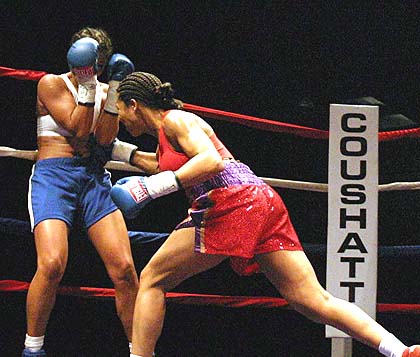
Copyrighted photo: J & P Photography
Twelve days separated MVPW-01 at London’s Olympia on April 5 from MVPW-02 at
Madison Square Garden’s Infosys Theater on April 17. Before the New York show
had much time to breathe, May 30 in El Paso was already on the board. For a side
of boxing that has often moved event to event, that sequence is the shining
story in women’s boxing.
Most Valuable Promotions launched MVPW in March with
numbered cards,
an ESPN agreement in the United States, and a Sky Sports deal in the UK and
Ireland. Put together, and the calendar logic comes into focus quickly. Elite
women’s fights now have recurring dates, recurring broadcast homes, and a
structure that starts to resemble a legitimate season of active competition.
When those dates arrive in clusters, the effect is practical
straight away. Venues can be booked earlier, broadcasters can
market further out, and fighters can see where the next
meaningful opening may sit.
Ultimately, the landscape of all-woman boxing cards is being
rapidly reshaped in 2026.
From showcase logic to serialized programming
For years, women’s title fights could land on mixed bills,
attached to crossover shows or deep inside a broadcaster’s wider
boxing slate. The nights could still be important, but they
often felt self-contained.
MVPW is trying to change that with sequential branding and
championship-level fights positioned as part of an ongoing
property.
Administrative on paper, maybe. In practice, it gives fans a
thread to follow from London to New York to El Paso. It also
gives promoters room to seed storylines earlier and gives the
women’s boxing calendar a shape people can actually track.
The first run of dates tells the
story
The early 2026 rollout is compact by design. It spans two
countries, multiple TV windows, and several title-level names in
less than two months.
Three dates that explain the
shift
● April
5, London, MVPW-01 opened at Olympia with Caroline Dubois vs.
Terri Harper and Ellie Scotney vs. Mayelli Flores on the main
card.
● April
17, New York, MVPW-02 became the inaugural U.S. event for the
platform, headlined by Alycia Baumgardner vs. Bo Mi Re Shin at
the Infosys Theater at Madison Square Garden.
● May
30, El Paso, MVPW-03 was announced for Stephanie Han vs. Holly
Holm in a rematch for the WBA lightweigh
The names grab attention, yes, but the sequencing is the bigger
tell: Numbered events, fast follow-up dates, and repeatable
branding give promoters and audiences something boxing rarely
offers in a clean form: continuity.
Broadcast windows are now part of
the build
The distribution piece is doing real work here. ESPN is the U.S.
home of MVPW through 2028, while Sky Sports and NOW will carry
two premium all-female MVPW events each year in the UK and
Ireland, which started with the London opener.
Sky Sports’ chief officer for the UK and Ireland, Jonathan Licht,
put it plainly in the March 31 Sky-MVP announcement:
“This agreement with
MVP underlines Sky Sports’ ambition to showcase the very best in
women’s boxing to sports fans and new audiences.”
A
woman’s title fight no longer has to be squeezed into an
existing slot to feel important. These nights arrive with their
own windows and their own rollout. Even small details, like the
April 5 card publishing region-specific start times well in
advance, point to more deliberate scheduling.
Sky already had evidence that the appetite was there. Its 2026
announcement pointed back to Claressa Shields vs. Savannah
Marshall in 2022, which drew more than two million viewers, and
to the Lauren Price vs. Natasha Jonas bill at Royal Albert Hall
in 2024.
High-profile all-women cards were already working, but the
missing piece, which was frequency, is starting to get filled.
Cleaner lanes for headliners
A
recurring platform changes who gets to sit at the center of the
promotion. Baumgardner, Dubois, Scotney, Shadasia Green, Han,
and Holm are the ticket, the TV copy, and the through-line from
one card to the next.
It
also changes planning for the fighters beneath the top names.
Champions get repeat headline billing, while contenders and
prospects enter a branded environment where audiences can learn
quickly.
MVP and Madison Square Garden Entertainment have additionally
said they want annual MVPW events at the venue over the next
three years, which gives New York a recurring place on the map
rather than a one-night stop.
The commercial footprint is
getting wider
Once dates begin to feel dependable, the business around them
changes too. Sponsors can buy earlier, outlets can cover the
sport as a continuing beat, and broadcasters can package rights
more cleanly.
Fight weeks also create the same digital halo that surrounds
other combat sports. Search traffic extends beyond fighter
names, weigh-ins, and ticket queries to include adjacent betting
and entertainment terms, including
new online casinos.
Notice to client: gambling site link is illegal in the state of
Washington: We have removed these active links leading to these
gambling casino ads. You are welcome to edit this article and
send legal links to be within the article. Email us asap about
this issue-- Email address:
wban100@aol.com
That spillover does not define the audience, though it does show
how these nights are being consumed, as broader live-event
properties rather than isolated one-offs.
Purists may not love that wider commercial frame, but it belongs
in the calendar conversation. Stable dates attract stable money,
and stable money usually buys more lead time, better undercards,
and fewer improvised gaps. And at the end of the day, that is
the backdrop for any serious discussion of women’s boxing
schedules in 2026.
2026 may be remembered for habit
formation
New boxing initiatives are often judged by whether they produce
one huge night.
Women's Boxing
rarely moves that neatly. Habit is usually the stronger signal:
a broadcaster holding space, a venue relationship repeating, a
fan already knowing the next date before the current card has
fully left the news cycle.
By
the end of the year, the clearest test may be sitting in the
schedule itself. Are elite women’s fights still being dropped
into borrowed slots, or are fans, media, and broadcasters
already circling the next numbered show while the current one is
still being recapped? If MVPW and the wider push around women’s
boxing keep that rhythm intact, 2026 will look like the year the
sport stopped waiting to be accommodated and started setting its
own dates.